Isogeometric Analysis (IGA)
Graduate course, TU Delft, 2026
Course overview
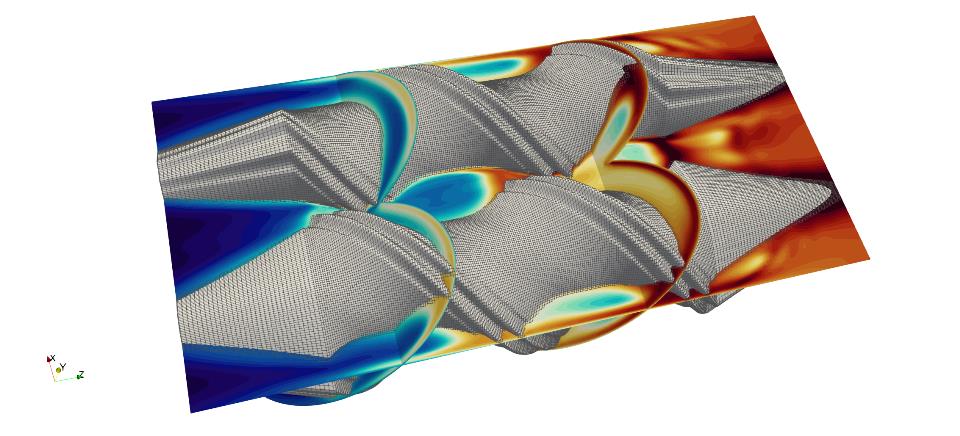
Isogeometric Analysis (IGA) is a computational methodology that tightly integrates Computer-Aided Design (CAD) and Finite Element Analysis (FEA) by using spline-based functions—such as B-splines and NURBS—for both geometry representation and numerical simulation.
By enabling higher-order smoothness and exact geometry representation, IGA provides significant advantages over classical finite element methods, particularly for applications involving:
- fluid and solid mechanics,
- multi-physics coupling,
- shape and topology optimization.
Originally motivated by practical engineering challenges, IGA has developed a strong theoretical foundation over the past two decades. This course aims to strike a balance between mathematical foundations, computational techniques, and engineering applications of IGA.
Learning objectives
After completing this course, students will be able to:
- understand spline-based geometry representations and their role in numerical analysis,
- formulate and solve linear and nonlinear PDEs using IGA,
- implement collocation- and Galerkin-based IGA methods,
- apply IGA to physics and optimization problems,
- critically assess the strengths and limitations of IGA in practical applications.
Teaching team
The course is taught by a lecturer team with complementary expertise:
- Stefanie Elgeti – Computer-aided design optimization
(DCSE visiting professor, TU Vienna) - Matthias Möller – Computational simulation and numerical methods
(TU Delft) - Ye Ji – Computer-aided geometric modeling and parameterization
(TU Delft) - Jingya Li – Fluid–structure interaction and multi-physics coupling
(TU Delft)
Course format and prerequisites
The course combines:
- lectures,
- hands-on programming exercises,
- practical examples,
- and a final project.
Prerequisites:
- Basic knowledge of numerical methods and numerical linear algebra,
- prior programming experience (MATLAB, Python, or C++).
Course materials
All course materials—including slides, exercises, and code examples—will be made available via Brightspace:
👉 https://brightspace.tudelft.nl/d2l/home/776010
Syllabus – WI4450
Special Topics in Computational Science and Engineering
Quarter 3 – Core lectures (7 weeks)
Lecture 1 – 10 February
Introduction to Computer-Aided Engineering (CAE) and design optimization with IGA;
overview of key components (geometry representation, objective functions, optimizers).
Lecture 2 – 17 February
Geometry modeling with B-splines and NURBS;
practical introduction to G+Smo and SplinePy.
Lecture 3 – 24 February
Surface and volume parameterization for analysis-suitable IGA
(Coons patches, geometry creation, and limitations).
Lecture 4 – 3 March
Collocation-based IGA for Poisson’s problem;
Greville abscissae, error analysis, and convergence rates.
Lecture 5 – 10 March
Galerkin-based IGA for Poisson’s problem;
variational formulation and numerical quadrature.
Lecture 6 – 17 March
Linear elasticity problems in IGA.
Lecture 7 – 24 March
Optimization algorithms and project kickoff.
Quarter 4 – Advanced topics and projects (7 weeks)
Lecture 8 – 22 April
Nonlinear Poisson’s equation;
defect correction, Newton–Raphson methods, derivative computation, and convergence enhancement.
Lecture 9 – 29 April
Fast matrix assembly techniques for Galerkin IGA
(e.g. weighted quadrature).
Lecture 10 – 6 May
Topology optimization.
Lecture 11 – 13 May
Immersed methods and solvers.
Lecture 12 – 20 May
Multi-patch IGA and coupling techniques
(e.g. Nitsche’s method).
Lecture 13 – 27 May
Advanced parameterization techniques.
Lecture 14 – 3 June
Robust optimization under uncertainty.
Final project presentations
18–19 June (all lecturers)