From geometric design to numerical analysis: Isogeometric CAD-CAE integration with DTATools
Date:日期:
Invited talk特邀报告 at ,School of Mathematical Sciences, Dalian University of Technology, Dalian, China
Slides, Photo 1, Photo 2, Photo 3
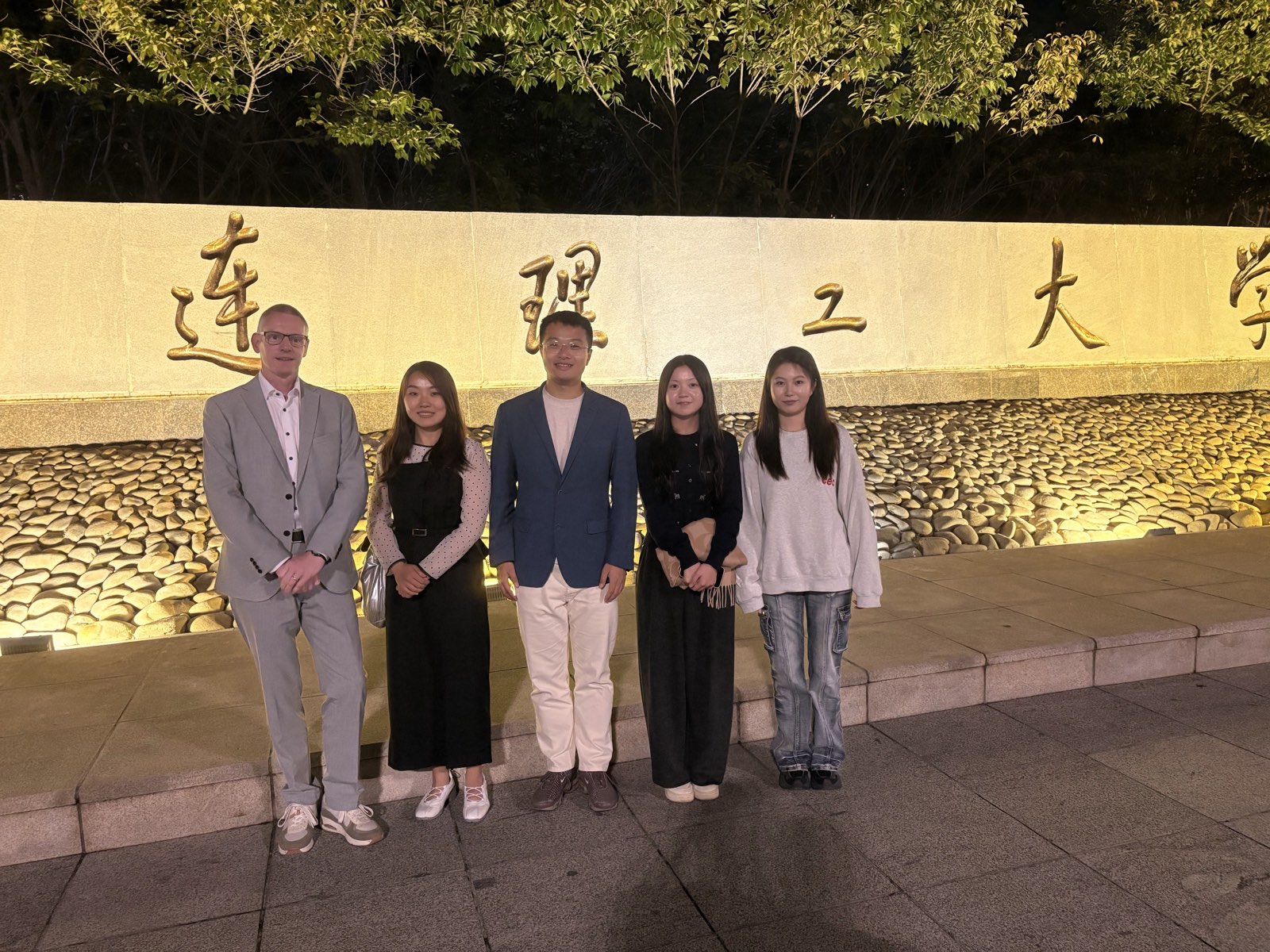
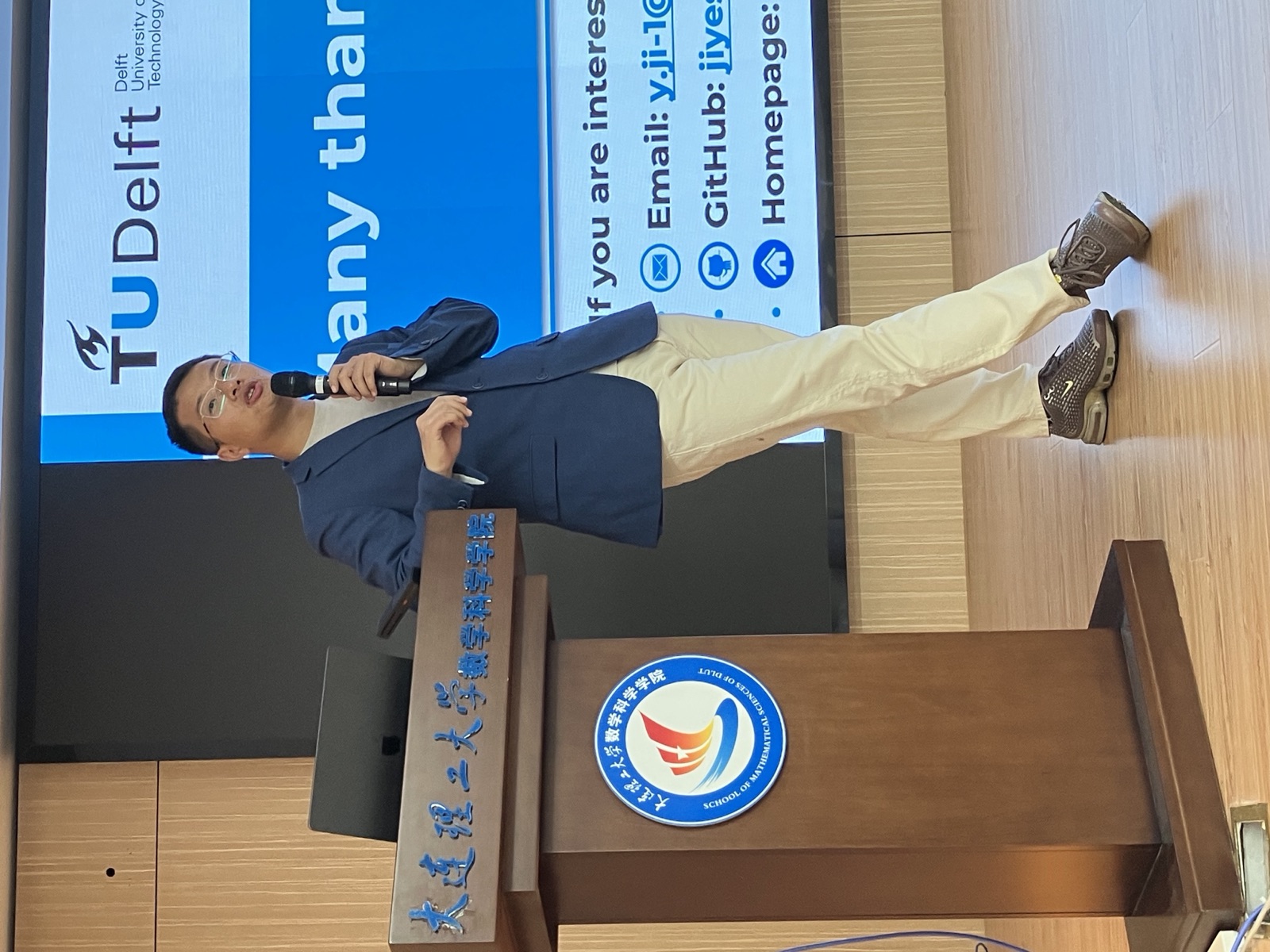
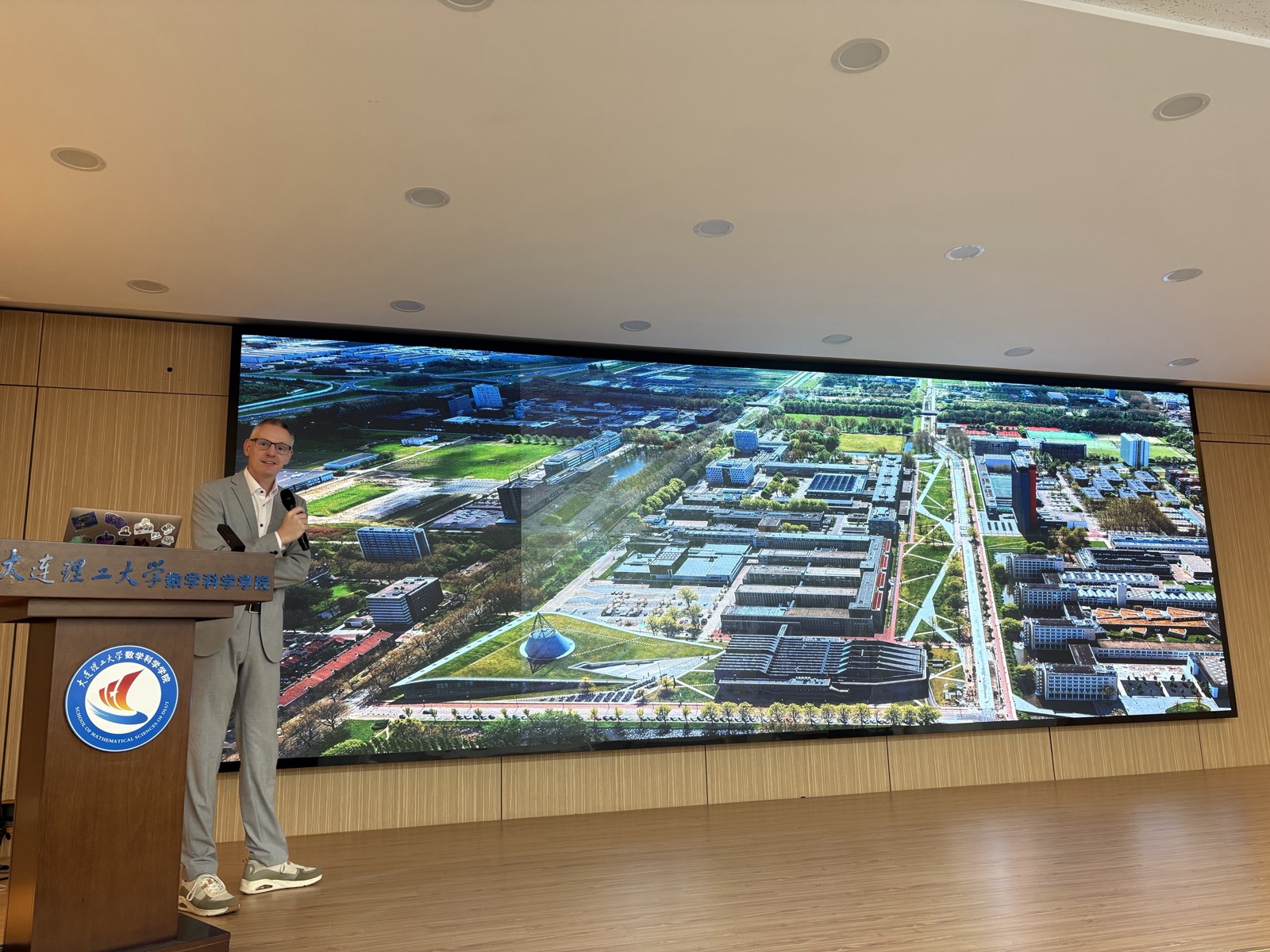
Invited talk (Monday, October 19, 2026, 15:30–16:30), given during a visit to Dalian University of Technology together with Matthias Möller and Jingya Li. The event was organized and hosted by Prof. Chungang Zhu; Prof. Yang Xia, Prof. Xuefeng Zhu and Ph.D. student Jingyi Cao also gave talks.
Integrating computer-aided design (CAD) with computer-aided engineering (CAE) requires bridging geometric modelling and numerical analysis. While CAD models describe geometric shape, numerical simulation imposes additional requirements on parameterization, geometric regularity, and approximation spaces. Transforming design geometry into an analysis-suitable representation therefore remains a central challenge.
Isogeometric analysis (IGA) connects geometric representation and solution approximation through spline-based constructions, providing a mathematical foundation for CAD–CAE integration. However, the use of common spline representations does not by itself guarantee a direct transition from design to analysis. The suitability of the geometric parameterization and its compatibility with the numerical discretization must also be addressed.
This talk presents our work on DTATools (Design-Through-Analysis Tools), focusing on the methods underlying an isogeometric design-to-analysis workflow. We discuss the differing requirements of geometric modelling and numerical simulation, the transition from CAD geometry to analysis-suitable models, and the implementation of these methods within DTATools. Relevant examples illustrate the computational workflow. Particular attention is given to the interplay between spline geometry, parameterization, and numerical approximation, alongside current limitations and open mathematical challenges.
My colleagues gave two further talks in the same session:
- “IGANets: Isogeometric Analysis Networks” — Matthias Möller (13:30–14:30; Photo 3). IGANets is a spline-based, physics-informed learning framework that maps problem parameters to the spline coefficients of the solution and enforces the governing equations through an isogeometric collocation loss, giving fast predictions across varying geometries and loading conditions.
- “Isogeometric Methods for Partitioned Fluid–Structure Interaction with Large Deformations” — Jingya Li (14:30–15:30). A spline-based coupling approach for partitioned FSI with G+Smo and preCICE, and a parameterization-driven arbitrary Lagrangian–Eulerian (ALE) formulation that re-parameterizes the fluid domain at each time step to avoid accumulated mesh distortion.
Keywords: Isogeometric Analysis, CAD-CAE Integration, Design-Through-Analysis, DTATools, Analysis-Suitable Parameterization